

Game Info – Halls of Hegra
Designer: Petter Schanke Olsen
Artist: Joeri Lefevre
Publisher: Tompet Games
Year Published: 2023
Player Count: 1
Solo Mode: Card-Driven
Initial Setup Time: 10 Minutes
Solo Play Time: 75-90 Minutes
Reset Time: 10 Minutes
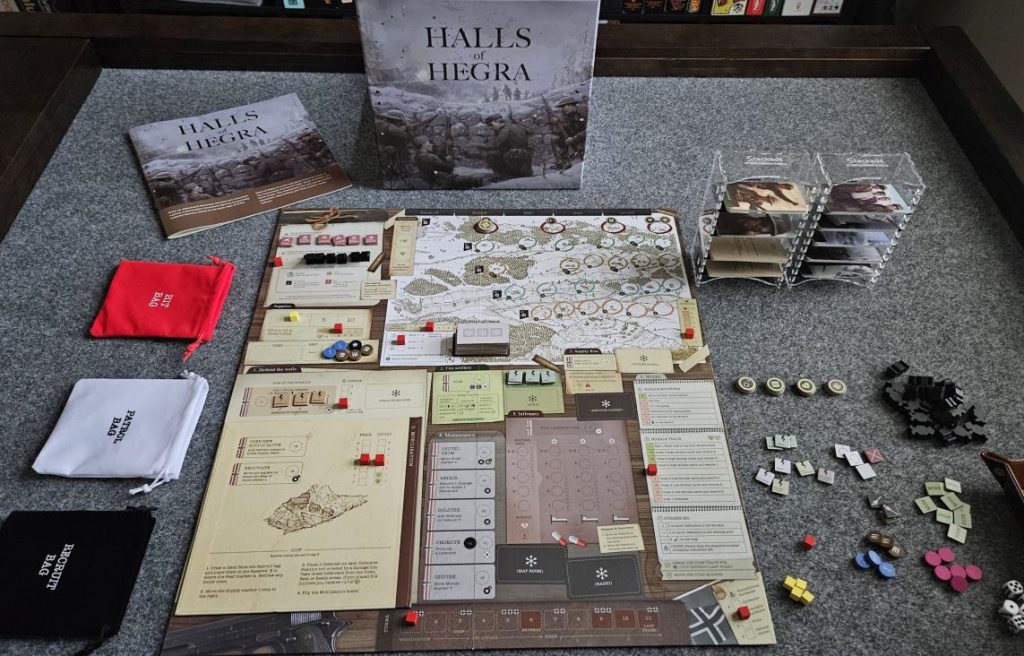
In Halls of Hegra, you are placed in the role of the Norwegian commander at Hegra during the 1940 siege by the German army. You must build up the fortress defenses and then withstand the inevitable attack.

For game purposes, the siege is divided into 3 phases – Mobilization, 1st Attack, and Siege.
During Mobilization, you add recruits to your forces, repair and bolster the fortress defenses, open supply lines, and shovel (a lot of) snow to uncover additional equipment and other helpful items.
The Germans arrive during the 1st Attack and you begin to repel the ground forces as you gather supplies and continue to prepare your defenses.
The Siege phase represents the full onslaught as German forces increase and artillery is brought to bear.
Victory is only achieved if enough of your forces remain after facing a “Last Stand” on the final turn (day 11).
It won’t be easy. The odds are not in your favor, and you have too much to do with not enough people to do it.
Something about this feels familiar
Halls of Hegra is, at its core, a tower defense game. The German ground forces arrive on turn 4 and their assault is relentless. Each turn adds new attackers as those that remain from previous turns move closer to your fortress.
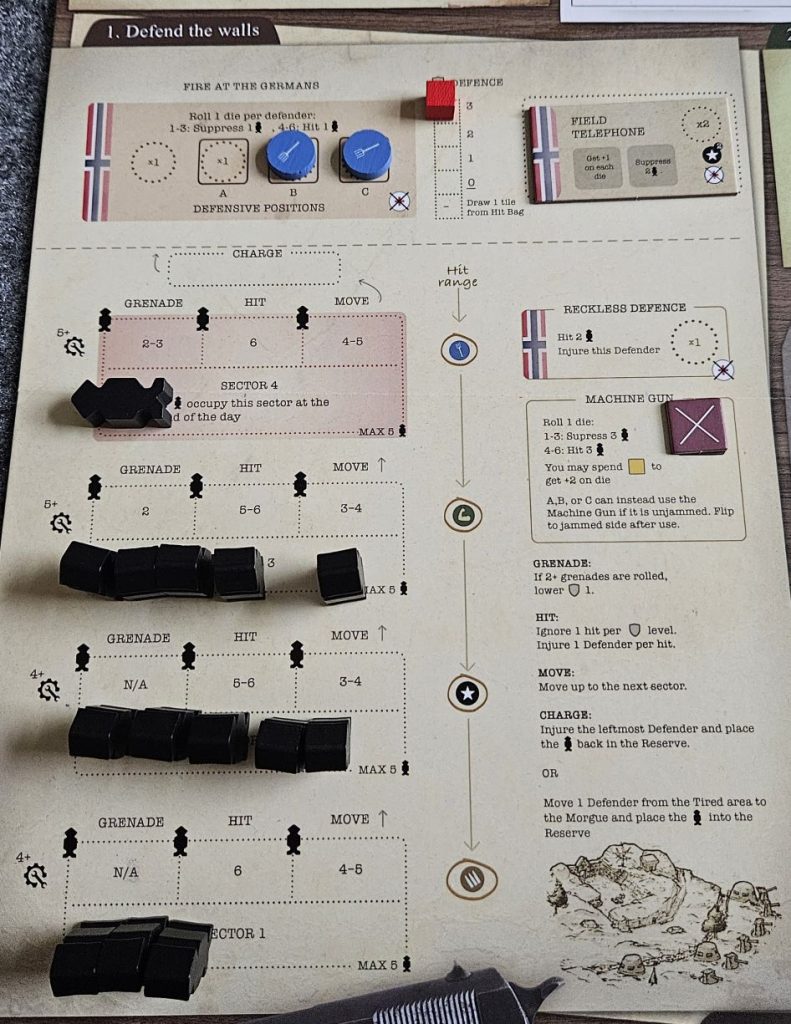
The game combines other mechanics, such as bag building and worker placement, to create an interesting war-themed game that plays like a Eurogame.
A common comparison is to the game Robinson Crusoe: Adventures on the Cursed Island. I can see that.
The Halls of Hegra game board looks similar to Robinson Crusoe, both in layout and color palette.
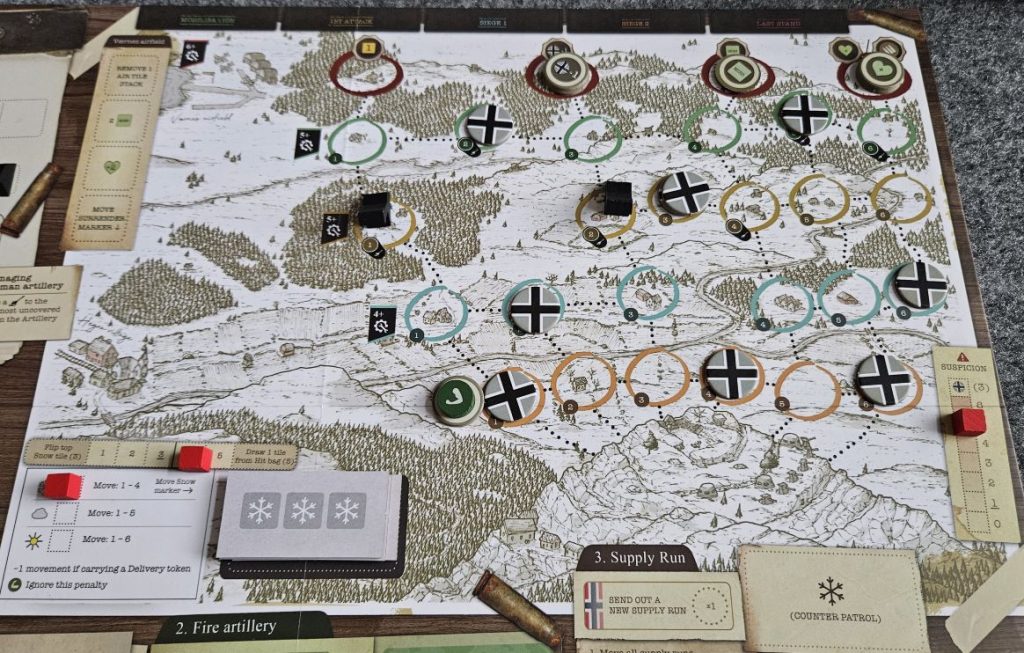
Both games require you to manage morale and feature many worker placement options, with too few available resources to perform every action you would like on a given turn. Both games can be punishingly difficult, especially if luck is not on your side.
Unlike Robinson Crusoe, Halls of Hegra simulates a single, real-world engagement. There is no scenario variety. This is not a negative, however. That focus allows every game element to tie directly to the theme of holding off the inevitable.
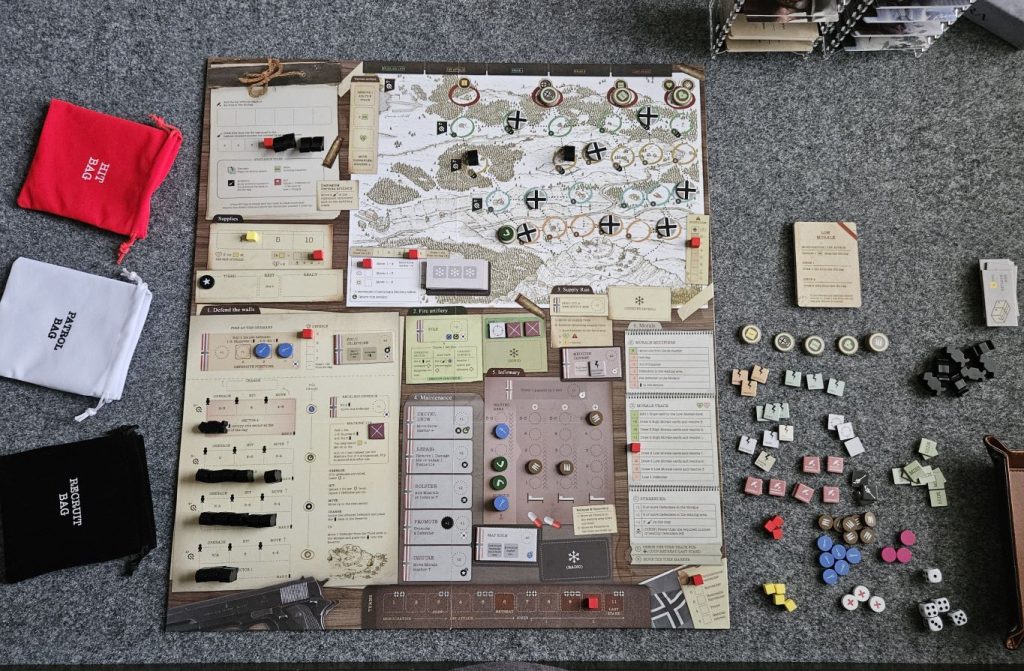
The bag building in Halls of Hegra is another difference. There are actually 3 bags to manage – a Recruit Bag, from which additional forces/workers are drawn; a Patrol Bag, containing German ground forces that disrupt your supply, and a Hit Bag, the contents of which determine the effects of artillery fire on your fortress. Each bag can contain both positive and negative items.
A mix of defenders
Your defenders are of several types, each with strengths and weaknesses.
Volunteers are the locals willing to join the fight, but they are untrained and do not excel at most basic tasks.
Hunters are more capable. Stronger than regular volunteers they can more efficiently shovel snow and carry supplies.
Medics can help injured defenders recover more quickly but they’re not as effective at most other tasks.
Soldiers are your best fighters. They can shoot the farthest and are the only defender type that can fire your artillery guns.
Your lone Officer is most effective at boosting morale, but can also fight and promote Volunteers and Hunters to Soldiers.
Has anyone seen the artillery guns?
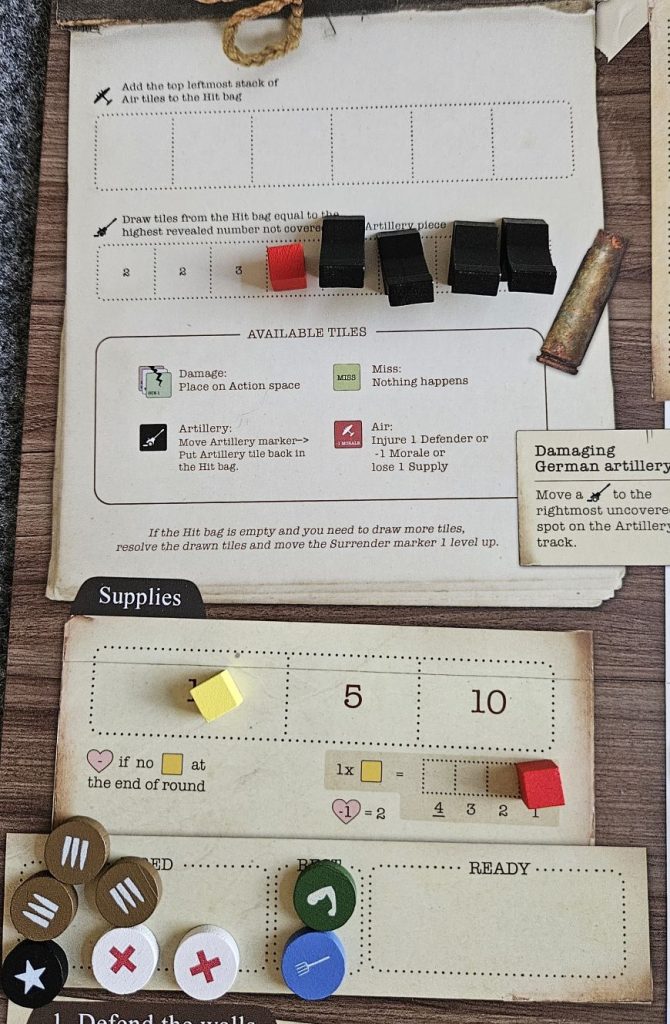
Available actions include firing at the German advance, performing supply runs, repairing equipment, bolstering general defenses, and shoveling snow.
Anyone in a colder climate knows that the latter action can be an exercise in futility. One day spent shoveling snow can be undone by the next day’s snowfall, but keeping on top of it is required to avoid negative consequences.
On the positive side, shoveling enough snow can allow you to draw random tiles from a “Snow Deck”, which may unlock additional action spaces, like a Radio, Map Room, or second Artillery Gun. Or the tile may instead provide random benefits such as morale boosts or supplies.
The Siege phase and late game
The Siege phase begins on turn 7 and lasts for the final 5 game turns.
The situation is desperate – more German infantry are closing in on the fortress, artillery fire is raining down on your defenses, equipment is being damaged faster than you can repair it, supplies are running low, infirmary beds are filling to capacity, and, if things go poorly enough, the morgue may be needed.
Can you repel the onslaught, maintain morale, and make a successful last stand? Will the Germans overrun your defenses or force a surrender?
Musings from the fortress
Halls of Hegra does an excellent job creating an atmosphere of desperation. Your limited resources force you to decide how much focus to place on offensive/attack actions versus defensive/supply actions each turn.
Chit pulls and dice rolls determine many outcomes and the luck of those, both good and bad, weigh heavily on your chances for success.
The Mobilization phase in the early game focuses on preparing for the coming German attack. One step in this phase includes drawing additional defender tokens from the Recruit Bag.
This involves a push-your-luck element, as tokens representing “Doubt” are periodically added to the bag alongside those representing your forces. You may draw up to 4 tokens each turn, potentially adding 4 defenders, but if you draw a Doubt token at any point, you must return to the bag all but 1 of your drawn recruit tokens.
Bad luck on these draws could leave you with as few as 3 defenders added during the entire Mobilization phase. Good luck could score you as many as 12.
More defenders allow more actions to be selected each turn. Good recruit draws can drastically increase your victory chances. Poor recruit draws could doom your efforts early.
Dice rolls are frequent and can also have a dramatic effect on how each game plays out.
For example, attack rolls, both yours and the Germans, dictate the number of attackers you remove and defenders you lose each turn.
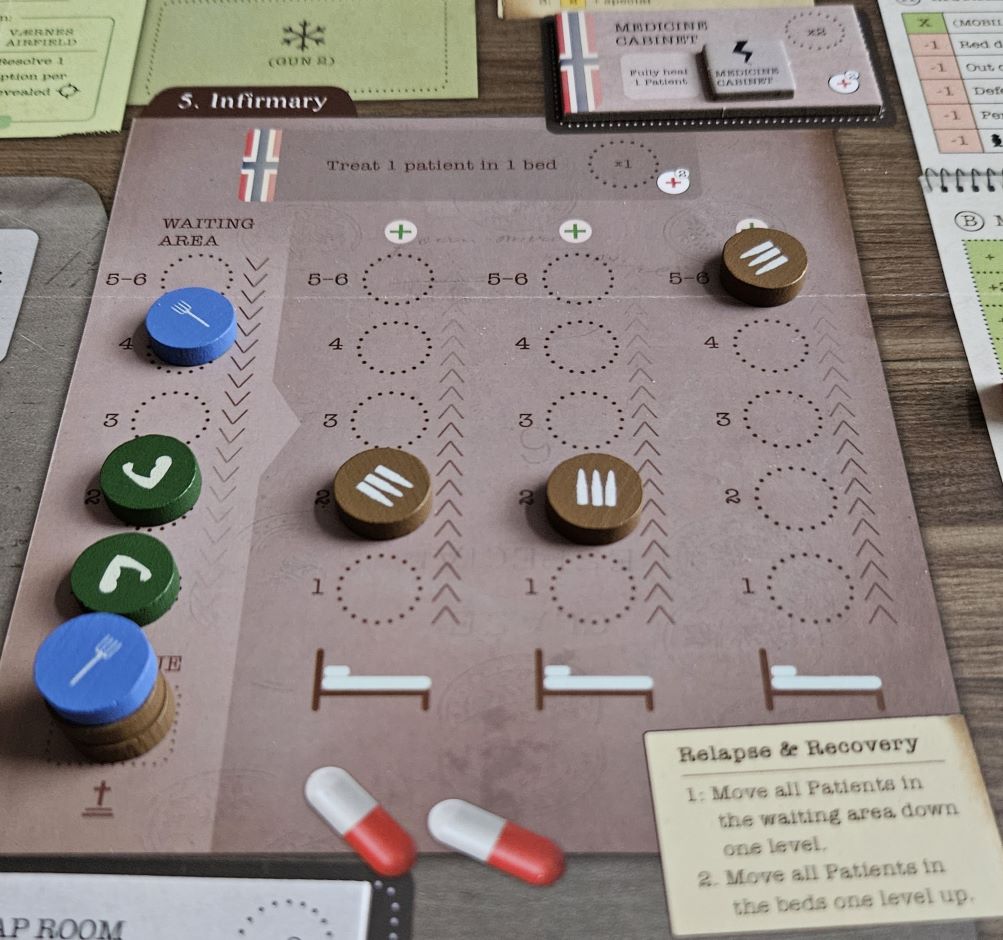
Another die roll determines how badly a hit defender is wounded. A high roll here could see the defender returned to action quickly. A low roll represents a more critical wound that can occupy an Infirmary bed for several turns, causing future wounded defenders into a Waiting Area and potentially the Morgue if a bed does not become available quickly.
There are additional chit pulls and dice rolls throughout.
The tension of each is part of the excitement, of course. Just be aware that luck can undermine even the best laid plans. This may be an issue if you prefer more deterministic outcomes.
3 reasons why Halls of Hegra might be right for you
1. Theme
The theme of a desperate defense against an overwhelming enemy permeates the game and its decision space.
If you enjoy historically themed games, particularly those set during World War II or covering under-explored battles, this is a stellar take on a real-life engagement that may be less familiar to many.
2. You enjoy a challenge
Tower defense games can be difficult by design and this game has quickly gained a challenging reputation.
Every action selection represents a balance of all that needs to be done versus the limited resources available to do them.
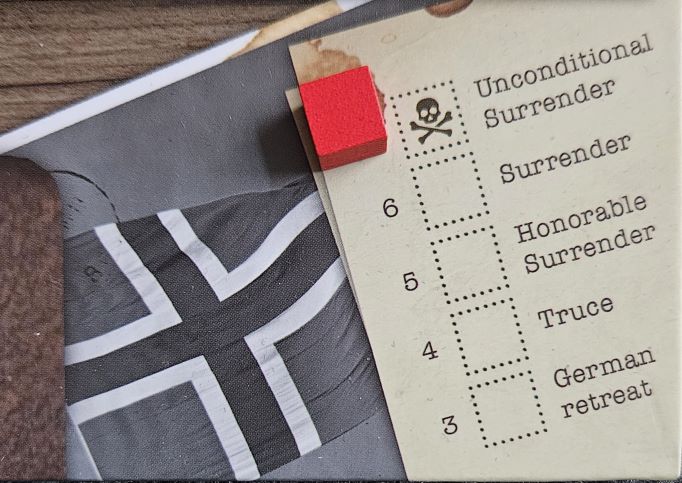
It is possible to force a truce or German retreat, but your ultimate surrender is the most likely outcome. An “Honorable Surrender” may feel like a moderate win.
3. “A WWII version of Robinson Crusoe” sounds intriguing
As noted above, comparisons to the board game Robinson Crusoe: Adventures on the Cursed Island are valid. Halls of Hegra presents a similar challenge in a much different setting.
Unlike Robinson Crusoe, which has a bit of a learning curve, Halls of Hegra is very approachable – both easy to learn and easy to play.
Does Halls of Hegra earn a place on my shelf?
Definitely! I enjoy thematic, strategic games and am no stranger to wargames or historical games in general.
Eurogame mechanics seem a perfect fit for representing a largely static defense and the familiar gameplay elements likely make the game approachable to a broad variety of players.
Halls of Hegra successfully marries its theme and mechanics to present a challenging representation of an early (and previously unknown to me) Norwegian WWII battle!
Leave a Reply