
Mage Knight is a well-known, well-regarded game currently ranked the #34 overall board game at BoardGameGeek.
It’s particularly popular with solo gamers. It was the #1 ranked solo game in the BoardGameGeek 1 Player Guild annual People’s Choice Top 200 Solo Games voting for many years, before being recently overtaken by Spirit Island.
It’s now firmly entrenched at the #2 solo game ranking. Not bad for a 13-year-old game!
But could Mage Knight be better?
I say “Yes”!
Sort of.
And hypothetically.
Let me explain…
Who am I to mess with perfection?
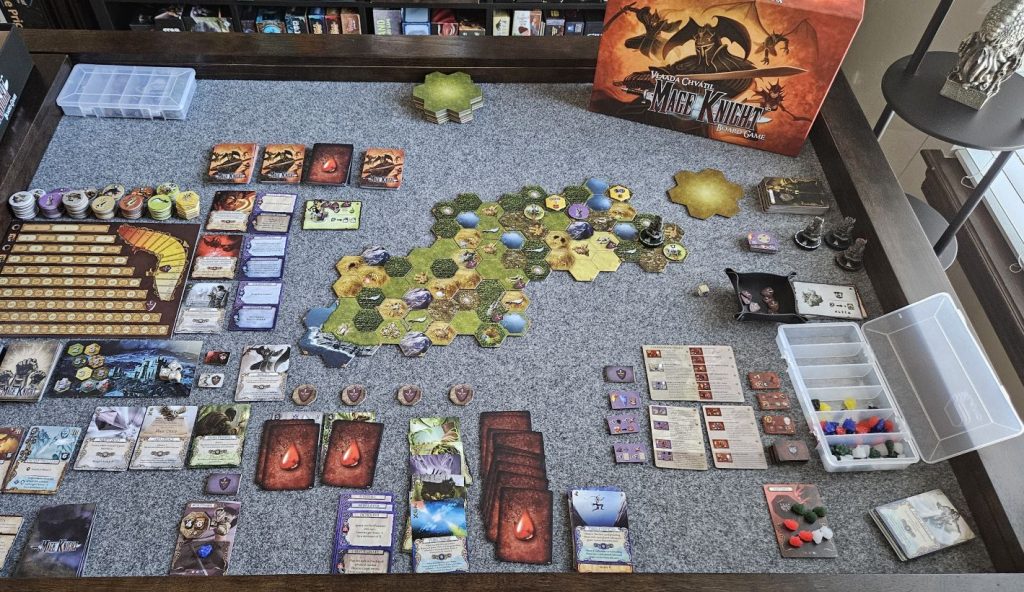
Let’s get this out of the way up front – I love Mage Knight!
Admittedly, I haven’t always felt that way. My recent article on Boomerang Games details how I sold my original copy shortly after returning to the board game hobby in 2014 and then reacquired it just last year.
I get it now. Mage Knight is a great deck building / hand management game.
Each session provides a strong sense of progression. You start out relatively weak but gradually expand and improve your deck of action cards over the course of a few rounds. By the endgame you’re capable of pulling off powerful card combinations to waylay multiple enemies and conquer whole cities.
Very satisfying!
I have no suggestions to improve the gameplay itself. It’s not needed and I’m not that smart.
But that doesn’t mean Mage Knight couldn’t be better.
About that learning curve
A common Mage Knight complaint is that it’s difficult to learn. I agree with that sentiment and find there’s a number of reasons why that is.
There’s a lot going on in Mage Knight
Cards control almost every action you take. And every turn is its own optimization puzzle, forcing you to determine how best to play your cards in-hand.
You play cards to move, fight enemies, recruit units to join you on your travels, generate mana to trigger stronger effects, train to gain new action cards into your deck…you can even burn Monasteries to the ground to gain powerful Artifacts!
Your actions increase your Fame and Reputation, allowing you to regularly Level Up. This, in turn, increases your hand size and unlocks new skills for future use.
You can do so much! But you can’t do everything.
Exploring the map

The map constantly expands as you move and explore new tiles. Some map spaces can’t be entered while enemy tokens occupy them. Other map spaces have to be entered to engage any enemy tokens present. Still other spaces contain no enemy tokens but can be figuratively “entered” to explore their dungeons and tombs to take on hidden enemies residing there.
Some tokens are always placed face up on the map. Some tokens are always placed face down. Some tokens are placed face up during a “day” game round and face down during a “night” game round (and then flipped face up when a new “day” round starts).
Some tokens are placed face down and flipped face up when the player occupies an adjacent space. Unless it’s a “night” round. Then the token doesn’t flip at all.
Different action costs in different locations
Several actions can occur in multiple locations, but each location carries a unique cost for it.
For instance, you can heal your Mage Knight in a Village or Monastery. Healing in a Village requires spending 3 “Influence” points, but you can heal in a Monastery by spending only 2.
Some map spaces will even heal your hero for free at the end of each turn you occupy it.

Combat is…unique
And detailed. It has 4 phases!

If you have the right cards, skills, or unit capabilities, you can perform a “Ranged Attack” before your enemy can attack you.
But not if they’re “Fortified”! In that case you can still attack them first, but only if you have available “Siege Attack” actions.
If you can’t attack first, then you have to block each enemy’s attack (or take Wounds for any attacks you can’t block). There are no partial blocks to reduce enemy damage. Blocking is all-or-nothing. You either block an attack or you take all of its damage as Wounds.
If the Wounds don’t Knock Out your hero, only then can you perform a regular attack to try to finish off the enemies.
Managing your mana

Magic puts the “Mage” in “Mage Knight”, but it’s not simply a matter of playing a card to cast a spell.
6 different Mana colors facilitate your most powerful actions and spells.
4 of the 6 Mana colors come in 2 forms – Crystals and Tokens (the other 2 can only be Tokens). Crystals can be stored for later use while Tokens are discarded at the end of the turn, whether they were used or not.
Some Mana is available from a common pool while some must be generated by you, via your cards or skills. The common Mana pool is determined by dice and typically changes each turn.
One Mana color is only usable during the day. Another color is only usable at night.
So much to keep up with!

With all these rules (and more I didn’t cover!) spread across 2 rulebooks, it’s easy to see that the learning curve is steep.
Given the unique mechanisms involved in the game, and the way some things behave differently depending on the game state, it’s a wonder the official FAQ is only 3 pages long.
Even with a firm grasp of the rules, there’s a lot for a solo player to keep track of throughout the game.
So, what about this “better” idea?
Mage Knight is an “evergreen” board game.
As of Q1 2024, it’s readily available at retail.
It has spawned several expansions, with a new expansion recently announced for a 2025 release.
In 2018, it was published in an Ultimate Edition.
It’s highly rated, it’s well-loved, it’s not going anywhere.
“The evergreen board game is the grail of every designer and publisher. It’s a game that is so well received–not just in terms of ratings, but in terms of actual sales–that it gets reprinted time after time, year after year.”
Stonemaier Games Blog – 10/29/2014
But it’s also over a decade old. Board game design and development has come a long way since 2011.
What if Mage Knight’s learning curve could be flattened a bit?
Losing To My Shelf’s Way-Too-Late List of Mage Knight Improvements
Suggested production changes to aid players in learning (or relearning) this great game
Wound Cards

These cards have so much unused space!
Healing point requirements could easily fit on the face of these cards – 1 Healing point per Wound card in hand, 1 Healing point per Unit Level for Wound cards on Units.
The costs to purchase Healing would fit as well – 1 Healing point for 2 Influence points spent at a Monastery, 1 Healing point for 3 Influence at a Village.
Even a Magical Glade’s “Healing Essence” effect could be shown (throw away a Wound from hand or discard pile when ending a turn on one of these spaces).
The cards could even include a “Knock Out” reminder when a single combat’s damage equals or exceeds your hand size.
Advanced Action Cards

Some Advanced Action cards are available for purchase via a Monastery’s Training action.
The cost to “learn” an Advanced Action (6 Influence points) could be printed somewhere on the face of each Advanced Action card.
The art on these cards is nice but there’s room for a few more icons.
Spell Cards

Spells can be learned at a conquered Mage Tower.
A Spell’s learning costs (7 Influence + a Mana token matching the Spell’s icon color) could similarly be printed somewhere on the face of each Spell card.
These cards have more text than the Advanced Action cards, but I think space could be found for a bit more iconography.
Enemy and Ruin Tokens

The back side of each Enemy/Ruins token could include icons indicating whether they are placed face up or face down (based on day/night and adjacency).
Space is admittedly a little tight on the backs, but the fronts of these tokens are already icon-heavy without being unreadable.
Alternatively, similar icons could be printed somewhere on the appropriate side of the Day/Night board. There’s quite a bit of unused space on it.
Shield Tokens

Instead of a single type of Shield token for all tracking functions, a few unique player tokens could denote a player’s City Leadership and Keep Ownership.
The same token design cut into a different shape would suffice.
These separate tokens could include icons to serve as reminders of hand limit increases when ending a turn on or adjacent to a Keep or City (+1 card for each owned Keep, +2 cards for a conquered City when playing solo).
Map Tiles – Exploration Costs

The backs of the map tiles are essentially blank, but they all cost 2 Movement points to explore.
The “2 Movement” exploration cost could easily be printed on each of them.
Map Spaces – Type and Movement Costs

All map spaces seem big enough to include some additional iconography.
At the very least, each site’s “type” icons could be displayed in a corner to help correlate which cards in the Unit Offer can be purchased at which locations.
It would be tight but, with the right iconography, each space’s Movement cost could be printed on the map as well.
The Movement costs are printed on the Day/Night board. And that’s nice. Having them printed directly on the map would be better.
Map Spaces – Fortified Sites

The “Fortified” icon could be printed on each Mage Tower and Keep space (and maybe even each City space, or certainly each City card) to remind players that units in those locations are Fortified.
Map tile space is limited but, with the right iconography, there could also be a visual indicator printed on each space indicating that Assaults require moving into the space and cost 1 Reputation.
Map Spaces – Marauding Enemies

Iconography could be printed on each Marauding Enemy space indicating the ability to challenge them from an adjacent hex.
Similar to the “Fortified Sites” Reputation cost suggestion above, icons could be added that indicate Reputation gains for defeating a Marauding Enemy (+1 for Orcs, +2 for Draconum).
And maybe even an icon to indicate that moving between adjacent spaces provokes a Marauding Enemy (although, I can see how the room for map icons might be getting a little tight at this point).
Map Spaces – Monasteries and Villages

Reputation costs to Burn a Monastery or Plunder a Village could be printed on each relevant space.
Healing point costs (2 Influence at a Monastery and 3 Influence at a Village) could be printed on each space as well.
As noted above, Healing costs would easily fit on the Wound cards, but duplicate information would not be a problem.
What did I miss?

Much of the difficulty in learning and remembering Mage Knight’s rules is that many things function differently in different locations or depending on the game state.
Adding visual cues and reminders wherever those differences are applicable would go a long way to reducing a player’s mental load and let them focus on planning turns and playing cards (which is taxing enough!).
Granted, a lot of the information recommended above is already printed on the included Site Description cards. Those cards are helpful, but they’re cumbersome to deal with because they’re small and double-sided.
I’m sure there are other ways to reduce the brain burn of learning and playing Mage Knight.
What suggestions do you have to make this great game easier to internalize and smoother to play?
Leave a Reply